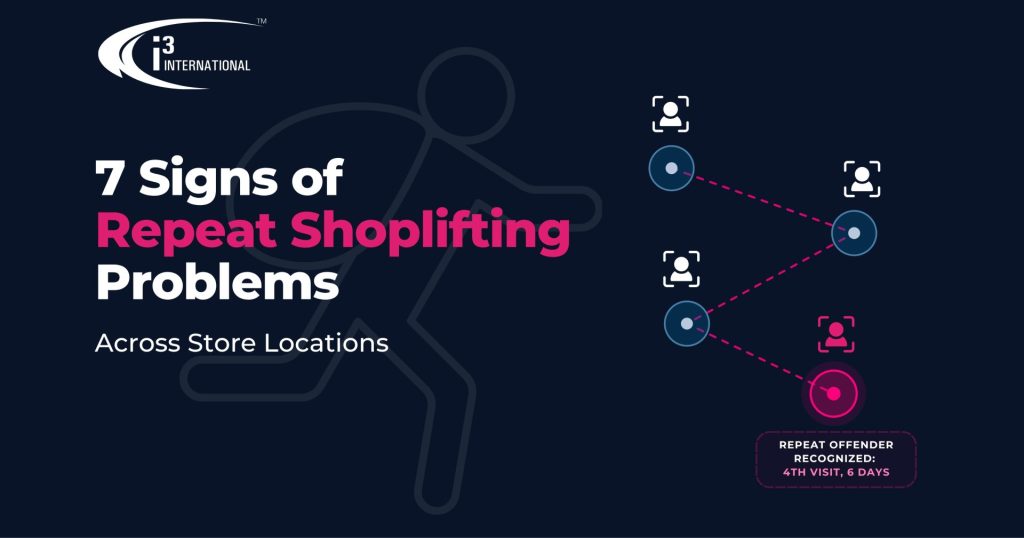
Retail shrink continues to climb, and a disproportionate share of it traces back to the same individuals hitting multiple locations. The challenge for loss prevention teams isn’t just catching theft in the moment, it’s connecting the dots across stores, shifts, and cities to identify repeat offenders before losses compound.
That gap has a measurable cost. One regional grocer deployed i3’s facial matching technology across 27 stores and flagged 1,124 repeat visits, uncovering over $370,000 in preventable losses that had been spread across the chain.
Here are seven signs and problems that point to repeat shoplifting across locations, and what current AI video intelligence can do about each one. The first five are signals to watch for. The last two are operational gaps that let repeat theft continue.
1- The Same Patterns Keep Appearing at Different Stores
The most obvious sign is also the hardest one to catch manually: the same suspicious patterns showing up at multiple locations in your chain within a short timeframe. With traditional systems, this requires an LP analyst to review footage from dozens of cameras across separate platforms, an impracticable workload at scale.
What to look for: Repeated anomalous activity at two or more locations within the same week, particularly during shift changes or peak hours when staff attention is divided.
How AI helps: Facial matching (i3’s Ai Sentry) detects repeat offenders and people of interest by recognizing individuals already known to your team. On its own, that tells you someone returned. Paired with movement pattern analysis (i3’s Ai Trajectory Anomaly) or exception-based transaction reporting (i3’s Smart-ER), each detection connects to what that person did, at which location, and when, through i3’s cloud platform. Together, these solutions make patterns searchable across your entire network.
2- Unusual Movement Patterns That Don’t Match Normal Shoppers
Repeat shoplifters develop routines. They know your floor plan, where cameras are positioned, and which aisles have blind spots. Their movement through the store looks fundamentally different from a genuine customer’s path.
What to look for: Individuals who move directly to high-value merchandise, spend minimal time browsing, avoid associate interaction, and take indirect routes to exits.
How AI helps: Movement pattern analysis uses real-time object detection to analyze how people move through your space. It identifies paths that deviate from normal shopping behavior, someone who enters through a side door, goes straight to electronics, and walks out without passing a register. These anomalies trigger alerts, not after a loss is reported, but while it’s happening.
3- Transaction Exceptions That Cluster Around the Same Time Windows
Repeat offenders aren’t always grabbing and running. Some exploit return fraud, coupon abuse, or employee collusion. The evidence shows up in your POS data, but only if you can connect those exceptions to video.
What to look for: Spikes in voids, no-sales, refunds without receipts, or high-value returns at specific stores during specific shifts.
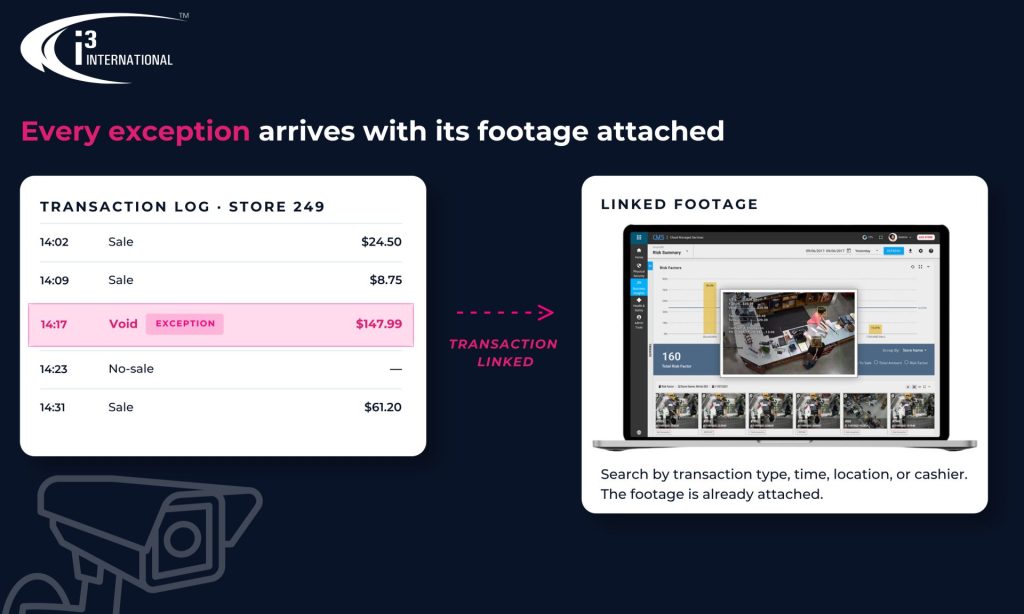
How AI helps: Exception-based reporting syncs video footage directly to transaction records. When an exception fires, a void, a no-sale, a return, the corresponding video is linked instantly. LP teams can search by transaction type, time, location, or cashier and pull up the footage in seconds. Its built-in “customer without transaction” detection flags individuals who enter, interact with merchandise, but never complete a purchase, a key signal for organized retail crime.
4- Incidents That Spike Right After Store Openings or Before Closing
Repeat shoplifters study your operations. They know when your staffing is thinnest, when managers are in the back doing counts, and when the store is transitioning between shifts.
What to look for: A pattern of losses or suspicious incidents concentrated in the first and last hours of operation, or consistently during mid-afternoon staffing dips.
How AI helps: People counting (i3’s Ai People Counting) with 98% accuracy gives LP teams real-time occupancy data across every location. Cross-reference low-staffing windows with loss events to identify when your stores are most vulnerable. Associate engagement analytics (i3’s Ai Employee Engagement) reveal which employees are actively engaging with customers during those periods, so you can adjust staffing or deploy targeted monitoring to deter theft.
5- Walk-Outs That Follow Predictable Exit Strategies
A first-time shoplifter panics. A repeat offender has a system. They know which exits lack coverage, which doors trigger alarms, and how to use shopping bags or carts to conceal merchandise past the last point of sale.
What to look for: Individuals exiting through non-primary entrances, bypassing checkout entirely, or leaving with unpurchased merchandise concealed in bags or under clothing.
How AI helps: Walk-out detection identifies individuals who pass through merchandise areas and exit without completing a transaction. It reads movement patterns in real time, so LP teams get actionable alerts based on what’s actually happening on the floor.
6- Your Stores Can’t Share Evidence Fast Enough
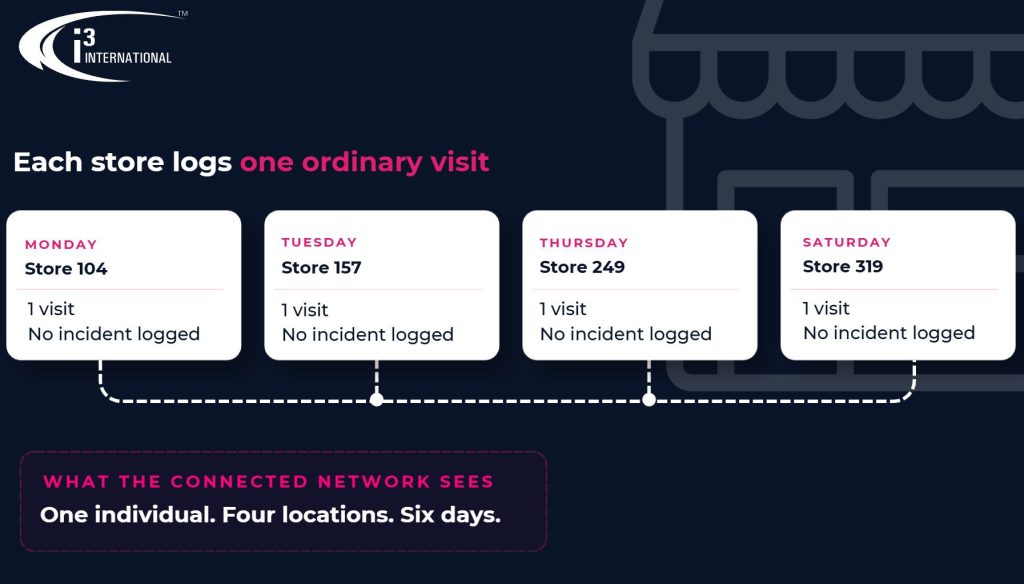
When a repeat shoplifter hits Store A on Monday and Store B on Thursday, the LP team at Store B usually doesn’t know about Monday’s incident. By the time incident reports are filed, emailed, and reviewed, the offender has moved on to Store C.
What to look for: Slow or inconsistent incident reporting between locations, LP teams operating in silos, no centralized system for sharing suspect information.
How AI helps: A cloud-managed platform (i3 CMS) centralizes video, alerts, and incident data across every location. When an incident is documented at one store, every LP manager in the network can access the footage, the report, and the associated transaction data. Encrypted video transfer (i3’s EVT) lets teams share evidence securely with law enforcement or internal investigators without worrying about chain-of-custody issues.
7- You’re Reacting to Losses Instead of Preventing Them
The clearest sign of a repeat shoplifting problem is that your team only finds out about it after inventory counts. By the time shrink numbers come in, the damage is done, and the offender has had weeks or months of undetected access.
What to look for: Shrink that consistently exceeds benchmarks, stores that repeatedly flag as high-loss without clear cause, LP teams spending more time on reports than on the floor.
How i3 International helps: A comprehensive ecosystem. The shift from reactive to proactive loss prevention requires real-time intelligence, not more cameras. i3’s integrated platform combines AI-powered detection, cloud-based multi-site management, and a unified integration layer (i3Host) that connects POS, access control, and third-party data into one view. Alerts fire in real time. Evidence is linked automatically. And every location operates from the same intelligence.
How to Detect Repeat Shoplifters Across Multiple Stores
To answer the question directly: detecting repeat shoplifters across multiple stores requires three capabilities working together.
- Integrated AI detection that combines facial matching with movement pattern analysis and exception-based reporting to identify anomalous movement, repeat offenders, and transaction exceptions at each location.
- Cross-site visibility that connects incidents, evidence, and alerts across your entire network in real time, not siloed systems that trap intelligence at individual stores.
- Video-to-transaction linking that ties every exception, every walk-out, and every incident to searchable, shareable video evidence.
i3 International delivers all three through a single, modular platform. Affordable enough to deploy across every location. Powerful enough to turn scattered footage into actionable data intelligence.
Your stores shouldn’t have to learn from the same loss twice.
Frequently Asked Questions
How do retailers detect repeat shoplifters across multiple store locations?
Detection across locations requires three capabilities working together: AI that identifies high-risk incidents need to be confirmed by an authorized person the severity of the incident, and what happened. If there’s a person related to said incident, they can then be categorized as a person of interest or unwanted visitor locally or across sites. AI can also identify anomalous activity at each site, alongside our i3Host platform that connects those events across the network in real time, and video linked to transaction records so every incident becomes searchable evidence. Any one of these three solutions on its own leaves gaps. A store can flag an incident and still have no way to tell the location twenty miles away. i3 can help your operations synchronize under a single pane of glass.
Can AI recognize the same individual at a different store?
Yes, through facial matching, which detects repeat offenders and people of interest that have already been logged and categorized into the database. Facial matching identifies the person. Movement pattern analysis and exception-based transaction reporting then supply the context that connects those detections to what happened, where, and when, across every site on one cloud platform. Facial matching paired with one of those two is what makes cross-store recognition actionable rather than isolated to a single location.
Can AI detect shoplifting without identifying individuals?
AI can identify high-risk behavior, under the supervision of human intervention, to analyze each incident with caution and privacy-in-mind. Movement pattern analysis uses real-time detection to read how people move through a space and flags paths that deviate from normal shopping, such as someone who enters through a side door, goes straight to high-value merchandise, and exits without passing a register. This reads movement rather than identity, so it does not recognize individuals on its own. Identifying a specific repeat offender requires facial matching alongside it.
What is exception-based reporting, and how does it catch theft that cameras miss?
Exception-based reporting monitors transaction data for events that fall outside normal patterns: voids, no-sales, refunds without receipts, high-value returns, and discount abuse. Each exception is linked to the corresponding video automatically, so an LP analyst can search by transaction type, time, location, or cashier and pull the footage in seconds. It also flags individuals who enter, handle merchandise, and leave without completing a purchase.
How does i3 approach privacy in repeat offender detection?
i3 builds privacy-conscious by design. The company is SOC 2 Type II certified, with encryption at rest and in transit and single sign-on. Privacy benchmarking against PIPEDA, Quebec’s Law 25, CCPA, and GDPR is in progress. Requirements around facial matching vary by province and state, so retailers should confirm their own obligations in the jurisdictions where they operate.
Do multi-site retailers need to replace their existing cameras?
i3’s platform is modular, and our cloud management and integration layers are designed so new AI solutions can deploy on existing infrastructure where camera coverage supports it. Zones with coverage gaps may still need additional hardware. A site survey establishes which locations can run the solutions as they stand.
Ready to See It in Action?
Book a demo with i3 to see how multi-site retailers use AI video intelligence to detect repeat offenders, reduce shrink, and build cases faster.