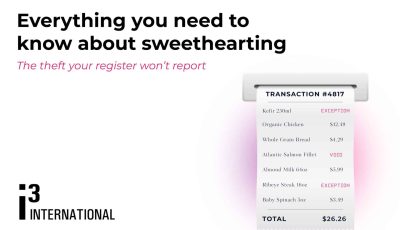

Employee theft costs U.S. retailers an estimated $26 billion every year, roughly 29% of total shrink, according to the Appriss Retail 2026 Total Retail Loss Benchmark Report. Within that category, one of the most persistent and difficult-to-detect forms is sweethearting: a cashier intentionally failing to scan items, applying unauthorized discounts, or giving away merchandise to someone they know.
The recipient is the “sweetheart,” a friend, family member, or coworker who walks out with goods the business never collected revenue for. It does not look like theft on camera, and it rarely triggers a cash drawer discrepancy. For most retail loss prevention teams, sweethearting is one of the hardest forms of internal shrink to identify and one of the most expensive to ignore.
This guide covers what sweethearting looks like in practice, why employees do it, what it costs, why standard security misses it, and how to build a detection and prevention program that works across locations.
1. What sweethearting looks like at the register
Sweethearting takes several forms, all centered on the point of sale. The cashier controls the transaction, and the person receiving the benefit is someone the cashier chooses to help.
Common methods include:
-Skip scanning: The cashier slides items across the scanner without letting the barcode register. In grocery, this often targets high-value products like meat, seafood, or specialty items. The POS log shows fewer items than what went into the bag.
-Unauthorized discounts: The cashier applies an employee discount, a coupon code, or a loyalty reward to a transaction that does not qualify. The sale completes at a lower total, and the difference never shows up as missing inventory.
-Voiding after checkout: Items are scanned normally, the customer pays a reduced amount or leaves, and the cashier voids specific line items after the fact. On paper, the void looks like a standard correction.
-Price overrides: The cashier manually enters a lower price for an item, sometimes disguising an expensive product under a cheaper SKU. A steak rings up as ground beef. A designer item rings up as a clearance piece.
-Gift card manipulation: An employee loads value onto a gift card without a corresponding sale, or applies a gift card balance that was supposed to be zeroed out.
In quick-service and convenience environments, sweethearting shows up as heavy pours, free menu items, or meals comped without manager approval. In every vertical, the mechanics are different, but the pattern is the same: a transaction completes, the register balances, and the business absorbs the loss as unrealized revenue.

2. Why employees do it (and why they rarely see it as theft)
Most employees who sweetheart do not believe they are stealing. A 2012 study published in the Journal of Marketing (Brady, Voorhees, and Brusco) surveyed nearly 800 retail service employees and customers and found that 67% said they had participated in sweethearting in the past two months. It remains the only published academic research specifically measuring sweethearting prevalence, a gap in the industry’s understanding of a behavior that costs billions annually. The finding still circulates widely across LP publications because the conditions that drive sweethearting have not changed: giving a friend a break feels like good customer service, not a criminal act. The employee is not taking money from the drawer. Nothing is physically removed from the store by the employee. In their framing, they are simply being generous with something that does not belong to them.
This cognitive gap makes sweethearting fundamentally different from cash register skimming or inventory theft. Employees who would never pocket $20 from a till will slide $40 worth of groceries past a scanner without hesitation.
Several factors reinforce the behavior:
-Low perceived risk. Because the register balances and the transaction looks normal, employees believe they will not be caught.
-Social reciprocity. Employees at one store give discounts to friends who work at another, creating a mutual arrangement that both parties treat as a professional courtesy.
-Cultural normalization. When sweethearting is common in a location, new hires absorb it as standard practice. Employees openly share techniques with coworkers because they do not treat it as something to hide.
-Tip incentives. In restaurants and bars, servers and bartenders give away appetizers or pour heavy to increase tips. The employee earns an extra few dollars per table while the business absorbs tens of dollars in lost margin.
Once a culture of sweethearting takes hold in a location, it compounds. It is not a single bad actor. It is an operational pattern that spreads through staff turnover, peer influence, and the absence of visible accountability at the register.
3. The financial weight retailers carry
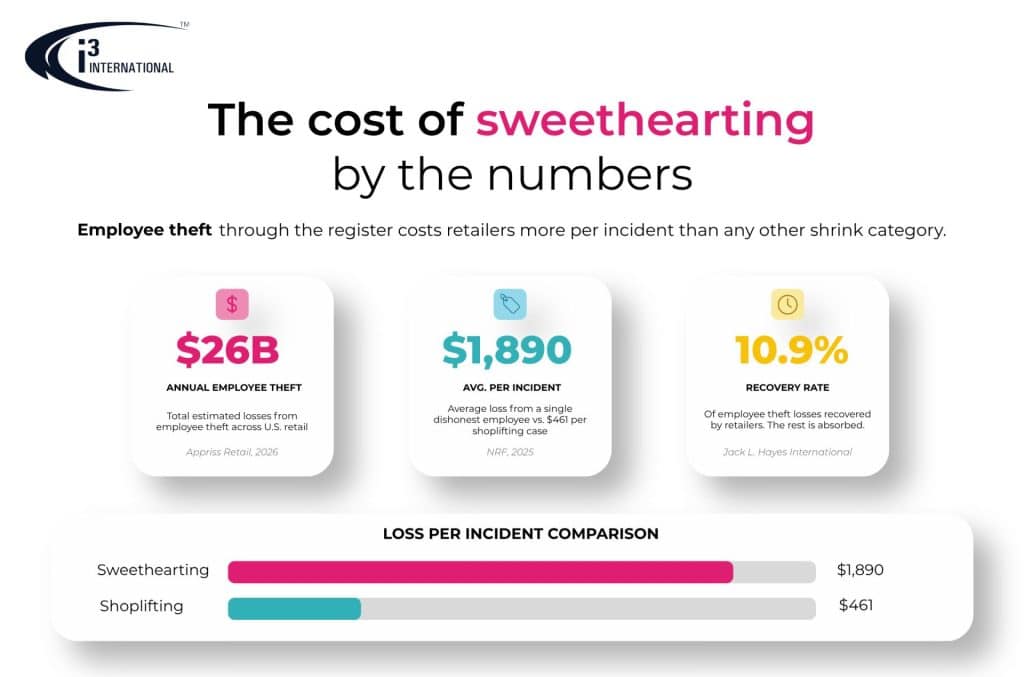
Employee theft accounts for 29% of total U.S. retail shrink, approximately $26 billion annually, according to the Appriss Retail 2026 Total Retail Loss Benchmark Report. Sweethearting is a significant contributor within that category because of how frequently it occurs and how long it goes undetected.
A few numbers put the scale in perspective:
– The average employee theft incident costs $1,890, compared to $461 for the average shoplifting incident, according to NRF data. Employee theft events are fewer in number but far larger in per-incident impact.
– Only 10.9% of employee theft losses are recovered through apprehension-based approaches, according to the Jack L. Hayes International Annual Retail Theft Survey. The other 89% accumulates silently until it surfaces in inventory counts or margin erosion.
– Total U.S. retail shrink reached $90 billion in 2025, according to the Appriss Retail 2026 Total Retail Loss Benchmark Report, with employee theft and external theft combining for roughly 65% of total losses.
Consider a single cashier who sweetheart-scans $30 worth of groceries for a family member once a week. Over a year, that is $1,560 in lost revenue from one employee at one register. Scale that across multiple locations, multiple cashiers, and a workplace culture that treats it as acceptable, and the annual impact reaches well into five or six figures for a mid-size retailer.
The challenge is that sweethearting losses are invisible in standard cash reconciliation. The items were never entered into the POS system, so the drawer balances perfectly. The loss only appears weeks or months later when physical inventory counts reveal gaps that no single transaction can explain.
4. Why standard security misses it
Traditional retail security systems are designed to catch two things: people taking products out of the store without paying, and employees taking cash from the register. Sweethearting bypasses both.
At the POS level, a sweethearted transaction looks legitimate. The register processed a sale, the drawer balanced, and a receipt was generated. There is no red flag in a standard end-of-day reconciliation because the missing items were never scanned in the first place.
On camera, a sweethearting event looks like an ordinary checkout. The cashier handles products, scans some items, bags everything, and the customer pays and leaves. Without the ability to compare what was on the counter to what appeared on the transaction log, a video review reveals nothing suspicious.
In inventory counts, sweethearting losses blend into general shrink. The missing products could be attributed to receiving errors, vendor shortages, shoplifting, or administrative mistakes. Without a specific transaction to investigate, LP teams have no starting point.
This is why sweethearting persists in organizations that already invest in cameras, POS systems, and inventory management. Each of those tools works well for its intended purpose. The gap is in connecting them. When transaction data, video footage, and pattern analysis operate independently, a cashier who skips two items out of twelve can do it for months without generating a single alert.
5. Five POS signals that point to sweethearting
Exception-based reporting changes the investigation by surfacing patterns that manual review would never catch. When a retail security system flags statistical anomalies at the cashier level, LP teams can investigate the right transactions instead of reviewing hours of footage.
Here are five signals that consistently indicate sweethearting activity:
Signal 1: Void rates above peer average
A cashier whose void rate significantly exceeds the store or district average may be voiding items after the sweetheart leaves. The void appears routine in isolation, but the pattern over time is distinct.
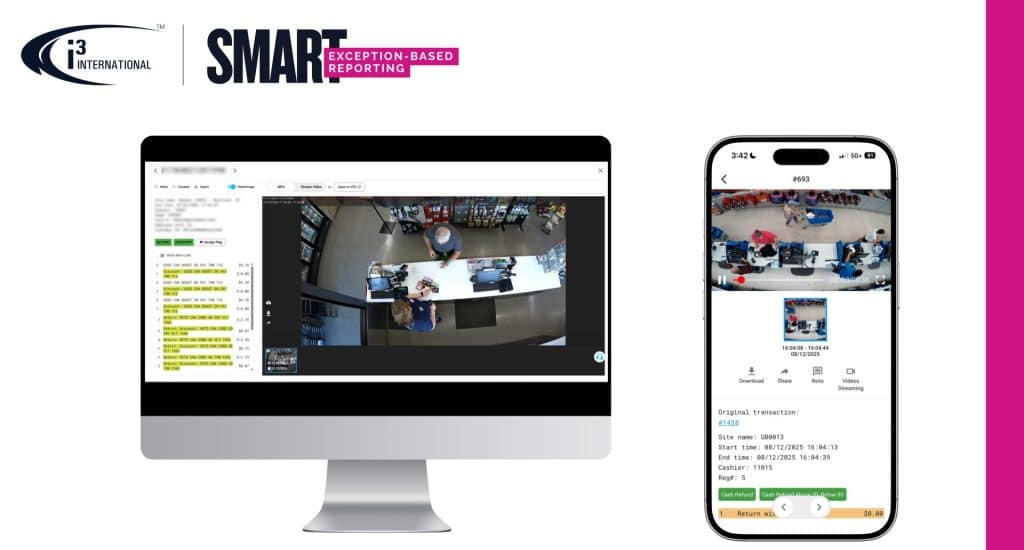
How AI helps: i3Ai Smart-ER ranks cashiers by exception frequency and pairs each flagged void with synchronized video, allowing AP teams to review the moment the void occurred rather than searching through hours of footage.
Signal 2: Discount frequency clustered by employee or shift
When unauthorized discounts cluster around one cashier or one shift window, the pattern points to deliberate activity rather than standard promotional application.
How AI helps: Smart-ER tracks discount application by employee, time of day, and transaction type, surfacing clusters that would be invisible in aggregate POS reports.
Signal 3: Price overrides without manager authorization
A cashier manually entering lower prices, especially on high-value items, without a manager approval code is a direct indicator. Each unauthorized override represents a potential sweethearting event.
How AI helps: Smart-ER flags price overrides that bypass standard approval workflows and links each one to the corresponding video footage for verification.
Signal 4: Transaction totals consistently below expected averages
When one cashier’s average transaction total falls significantly below their peers, and they handle a similar product mix and customer volume, the gap suggests items are leaving the counter without being scanned.
How AI helps: i3Ai People Counting provides foot traffic data by register area, giving LP teams the ability to compare customer volume against completed transaction counts. A persistent gap between the two signals that something is leaving without being rung up.
Signal 5: Low item count relative to customer volume
When a cashier consistently processes fewer items per transaction than peers handling similar customer traffic, the pattern suggests items are being handled but never scanned.
How AI helps: Smart-ER’s exception reporting surfaces cashiers whose average item counts per transaction fall below store or district benchmarks, and pairs each flagged transaction with synchronized video so LP teams can verify what was on the counter versus what the register recorded.
6. How exception-based reporting changes the investigation
The traditional approach to internal theft investigation starts with a general concern and works backward through footage. An LP manager selects a cashier to review, pulls video from their shifts, and watches for irregularities. This can take hours per employee and still miss events that look normal on camera.
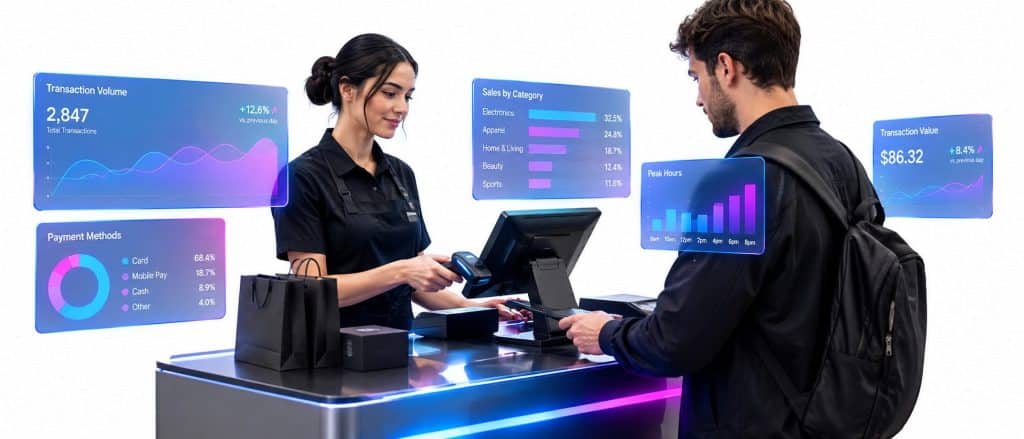
Exception-based reporting reverses the workflow. The system analyzes every transaction across every register and every location, identifies statistical anomalies, and presents the highest-risk events with video already attached. The investigator starts with a flagged pattern and verifies it with footage, rather than starting with footage and hoping to spot something.
i3Ai Smart-ER automates this process. It ingests POS data, applies AI-driven exception detection to identify voids, cancellations, returns, discount anomalies, and high-risk transaction patterns, then pairs each exception report with the corresponding video footage. AP teams can search by transaction type, time, location, or cashier and review incidents with synchronized audio and video evidence.
For multi-location retailers, i3 CMS centralizes this data across every store, so district and regional LP managers can compare exception patterns across locations from a single dashboard. And when an investigation produces evidence that needs to go to law enforcement, EVT (Encrypted Video Transfer) provides a secure, tamper-proof method for sharing that footage.
The shift from reactive to proactive investigation is what separates organizations that catch sweethearting early from those that discover it in an annual inventory audit.
7. Building a sweethearting prevention program
Detection is half of the equation. A sustainable prevention program addresses the behavior at its root and makes the operational cost of sweethearting visible to the people responsible for it.
Define sweethearting explicitly in your employee handbook. Many employees do not realize that giving away merchandise, even a $1 soda, is classified as theft. The policy should state clearly that intentionally failing to scan items, applying unauthorized discounts, or providing free goods to anyone constitutes grounds for termination.
Include sweethearting in loss prevention training for every new hire. Show real examples of how it happens, how it is detected, and what the consequences are. When employees understand that POS exceptions are being monitored and paired with video, the deterrent effect is immediate.
Require manager authorization for price overrides, voids above a threshold, and employee discount applications. This adds a checkpoint that makes sweethearting harder to execute without creating friction for legitimate transactions.
Run regular exception audits, not just annual reviews. Monthly or weekly review of the highest-risk POS exceptions, paired with video verification, keeps the program active and visible. When employees know that audits happen regularly, the perceived risk of sweethearting increases.
Maintain the conversation. Sweethearting re-emerges when LP training becomes a one-time event. Ongoing reminders during team meetings, updated training materials, and visible accountability keep it from normalizing again after the initial program launch.
Invest in the technology that connects POS, video, and analytics. Policies and training set the expectation. Technology provides the operational visibility to enforce it across every location, every shift, and every register without adding headcount. A platform like i3Host ties POS data, video, and operational analytics into one unified view, giving LP teams the ability to monitor and investigate from anywhere.
How can retailers detect and prevent sweethearting?
Retailers can detect and prevent sweethearting by combining clear workplace policies with AI-powered exception-based reporting that connects POS data to video footage. Here are the essential steps:
1. Deploy exception-based reporting that automatically flags POS anomalies (voids, unauthorized discounts, price overrides, scan gaps) and pairs each event with synchronized video for verification.
2. Establish clear policies that define sweethearting as theft, require manager authorization for overrides and voids, and outline consequences for violations.
3. Monitor at the cashier level across all locations, comparing individual exception rates to peer averages rather than relying on aggregate store-level metrics.
4. Integrate POS, video, and foot traffic analytics so that LP teams can correlate transaction patterns with in-store activity and identify gaps between customer volume and completed sales.
5. Conduct regular exception audits paired with video review, making the program visible and ongoing rather than a one-time training event.
Ready to see it in action?
Sweethearting lives inside completed transactions that look normal until the right tools connect the data. Closing that gap starts with pairing every POS exception to synchronized video, across every register and every location.
If your retail loss prevention program is running on cameras and cash counts alone, there is a gap in your visibility at the register.
Request a demo to see how i3Ai Smart-ER pairs every POS exception with synchronized video, giving your LP team the evidence they need to act.
Sources
- Brady, M. K., Voorhees, C. M., & Brusco, M. J. (2012). “Service Sweethearting: Its Antecedents and Customer Consequences.” Journal of Marketing, 76(2), 81-98.
- Appriss Retail. (2026). 2026 Total Retail Loss Benchmark Report.
- National Retail Federation. (2025). The Impact of Retail Theft & Violence 2025.
Frequently asked questions
What is sweethearting in retail?
Sweethearting is a form of employee theft where a cashier deliberately fails to charge a customer for goods or applies unauthorized discounts. The recipient is typically someone the employee knows personally, such as a friend, family member, or coworker. It differs from other forms of internal theft because the employee does not take cash or products directly. The business loses revenue through transactions that complete at reduced totals or with items that were never scanned.
How common is sweethearting among retail employees?
A Journal of Marketing study that surveyed nearly 800 retail service employees and customers found that 67% admitted to participating in sweethearting within the previous two months. The behavior is one of the most frequently cited forms of internal theft across industry LP surveys, in part because employees who sweetheart often do not perceive it as theft.
What is the difference between sweethearting and shoplifting?
Shoplifting is external theft where a customer takes merchandise without paying. Sweethearting is internal theft where an employee facilitates the removal of merchandise by intentionally undercharging or not charging a customer. Shoplifting can often be detected through cameras and electronic article surveillance. Sweethearting is harder to detect because the transaction appears to complete normally, the register balances, and the event looks unremarkable on standard video review.
Can video surveillance alone detect sweethearting?
Standard video surveillance is not sufficient on its own because a sweethearting event looks like a normal checkout on camera. The cashier handles products, scans some items, and bags everything. Without correlating what appeared on the counter with what the POS logged, there is no visible anomaly. Effective sweethearting detection requires integrated retail security systems that pair video footage with POS exception data, allowing LP teams to see both what the cashier did and what the register recorded.
What technology is most effective for sweethearting prevention?
Exception-based reporting integrated with video analytics is the industry standard for point-of-sale theft prevention. Systems like i3Ai Smart-ER analyze transaction data across every register and location, flag statistical anomalies, and automatically pair each exception with synchronized video. This allows LP teams to investigate specific events rather than reviewing hours of footage, reducing investigation time and increasing detection accuracy.
Does sweethearting affect franchise locations differently?
Franchise locations can be particularly vulnerable because individual operators may have less LP infrastructure than corporate-managed stores. Franchise location monitoring through a centralized platform allows operators to compare exception patterns across locations, identify outliers, and apply consistent accountability standards. Remote video surveillance tied to POS analytics gives franchise owners the same visibility that larger retailers build into their corporate LP programs.