Grocery asset protection is having a better year than the headlines suggest, and grocery technology budgets are part of the reason. Two forces define this moment. Food retailers roughly doubled technology spending as a share of sales in a single year, while shrink reduction shifted from a loss prevention function into an enterprise-wide discipline. Both trends are encouraging, and both point to the same opportunity for grocery operators in 2026.
Grocery technology spend roughly doubled in 2025
Food retailers roughly doubled technology spending as a share of sales between 2024 and 2025. The sector committed more than $20 billion to technology budgets in 2025, close to 2% of total sales, and 71% of responding grocers expect those costs to rise again in 2026.
Ai adoption moved at the same pace. The share of food retailers using AI rose from 47% to 68% in one year, and every responding supplier now uses AI in some form.
The framing around those numbers is the part worth pausing on. Grocery leadership has spent years treating operational efficiency and customer experience as competing priorities, weighing the gains of one against what it cost the other. FMI’s finding is that technology investment now lets grocers deliver both, turning what had been an either-or consideration into a “both-and victory.” More than half of responding retailers and suppliers say their investments are already paying off in their businesses and in what they offer customers
The findings rest on a substantial base. FMI and David Orgel Consulting collected responses in February 2026 from 70 food retailers and wholesalers, alongside regulatory documents filed by eight publicly traded companies, together representing more than 42,000 stores.
Grocery shrink reduction is working, and it is no longer only a loss prevention function
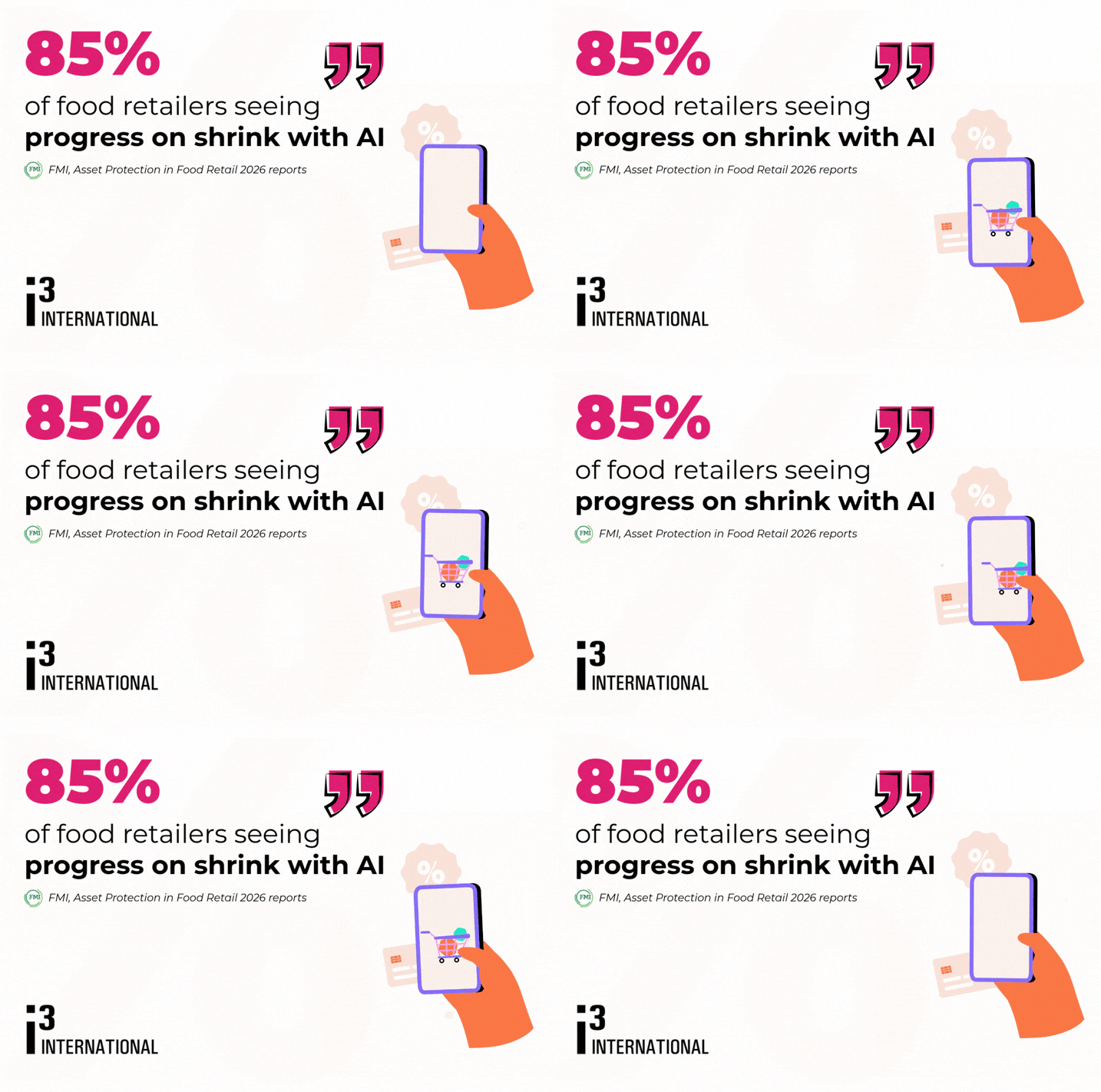
Food retailers are making measurable and durable progress against shrink. FMI’s Asset Protection in Food Retail 2026 research found that 85% of food retailers report at least some success in meeting their shrink reduction goals, and more than one in five describe themselves as very successful. Those results held steady year over year, which points to sustainable strategy rather than a short term trend.
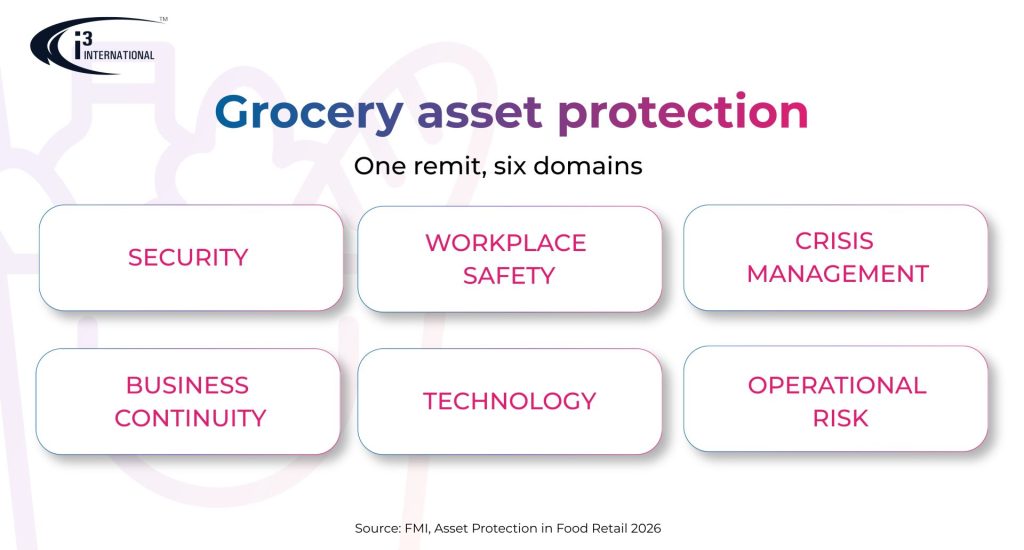
The structural change behind those numbers matters. Grocery asset protection leaders now work across security, workplace safety, crisis management, business continuity, technology, and operational risk rather than owning shrink alone. Tom Cosgrove, Director of Industry Relations at FMI, reports that discussion at this year’s Asset Protection and Grocery Resilience conference centered on identifying vulnerabilities early instead of reacting to incidents after the fact.
Self-checkout shows the shift clearly. Grocery retailers report less concern about self-checkout shrink than they did a year ago, which FMI attributes to improved oversight, better technology, and tighter store-level procedure.
Cosgrove is direct about the limits, noting that “technology alone is not the answer.” FMI describes the progress as the product of a layered approach, combining video monitoring, security personnel, push-out prevention, theft-prevention technology, and formal shoplifting programs with well-trained teams.
Review capacity sets the ceiling on grocery asset protection results
Grocery technology budgets buy detection, and they do not buy the hours required to review what gets detected. Only about 10% of food retailers believe the systems they are adopting will help them reassign staff, while more than half expect to add data analytics or digital technology specialists, and 70% expect operating costs to increase this year.
Grocers ran on net profit margins averaging 2.1% last year. At that margin, an hour an investigator spends assembling a case out of separate systems is an hour that returns nothing.
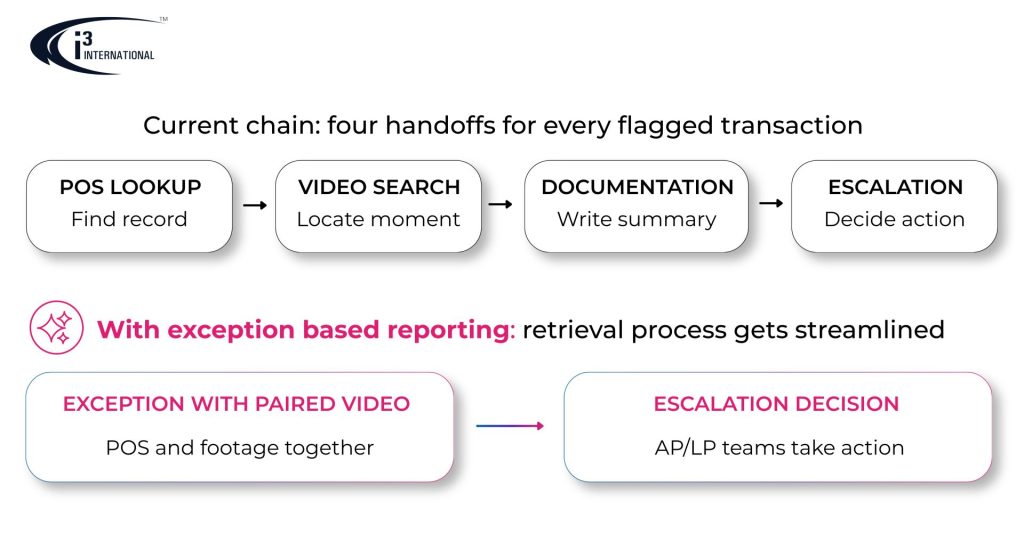
The number that governs this is investigation time per incident. A single flagged transaction can send an analyst through point of sale (POS) logs, then camera timelines, then documentation, then a decision about whether to escalate. Multiply that across a store fleet and the arithmetic stops working.
When that cycle stays long, flagged activity ages out of the retention window before anyone opens it. The layered approach FMI credits for the industry’s progress starts thinning at the review step, which is the least visible place for it to give way.
How i3 Smart Exception Reporting helps grocery teams work more of what they flag
i3’s Ai Smart Exception Reporting, known as Smart-ER, shortens the distance between a flagged transaction and a closed case. Smart-ER integrates POS transaction data with synchronized video evidence, so a grocery investigator reaches the relevant moment directly instead of searching for it. It works with the cameras and POS systems a grocery operation already has in place.
Preventable losses become visible and recoverable. Over one year, i3 helped a 27-store regional grocer surface more than $370,000 in preventable losses, with an estimated $250,000 in annual savings. Those results came from existing camera and POS infrastructure rather than a new estate.
Checkout fraud gets caught rather than reconstructed. Smart-ER helps grocers cut checkout fraud by flagging fraud, voids, and theft at the register. Asset protection spends less of the week proving what happened and more of it acting on it.
Push-out prevention gets an alert instead of a post-mortem. i3’s Ai Trajectory Anomaly solution triggers alerts on cart pushouts and walk-outs at grocery exits. Store teams get the chance to respond during the event rather than reconstructing it days later.
Shrink patterns become visible across the fleet. i3’s Operational Risk Intelligence identifies shrink trends across the organization and reduces the noise in abnormal transactions, helping grocery teams locate theft rings and repeat patterns spanning multiple locations. Regional and corporate asset protection see the same picture as the store.
How i3 Smart-ER fits existing grocery infrastructure
i3 International’s Ai powered video analytics platform integrates with the cameras and POS systems a grocery operation already runs, which keeps the investment incremental rather than a rip and replace. Smart-ER sits inside the broader i3 Ai ecosystem alongside People Counting and Customer Overflow for checkout and deli queue management, and safety and compliance monitoring for issues such as blocked emergency exits and slip and falls. Grocery operators can add capability by zone rather than replacing the estate at once.
What grocery operators should decide next
Grocery technology spending has already doubled, and 71% of grocers plan to increase it again in 2026. The separation over the next two years will not come from which grocers adopted AI, because most already have. It will come from which grocers built the capacity to act on what their systems surface.
That makes this a question of timing rather than direction. Grocery operators who lower investigation time per incident now will work through far more of what their existing investment already produces, and they will do it while the industry’s shrink numbers are already moving the right way.
Ready to find out how much investigation time your grocery stores could recover?
Request a demo and we will walk your asset protection and store operations teams through i3 Smart Exception Reporting against your own workflow.
Learn more about i3 International’s solutions for grocery stores.