
According to a 2024 RAND Corporation report, the percentage of teachers who feared their students would experience an attack or harm at school increased from 34% in fall 2022 to 47% in fall 2023, a 13-percentage-point increase.. That shift does not belong in a footnote. It belongs in every budget conversation about school safety, campus security, and long-term school security planning.
Boards feel it. Parents feel it. Superintendents carry it into capital planning, summer service windows, and every discussion about what the district can afford to improve this year versus what it cannot afford to miss.
That is also where too many school security system conversations go wrong. The market tends to respond with product language when district leaders need operating language. The real decision is not just what to buy. It is how the district will maintain visibility, protect privacy, recover footage quickly, and keep its school surveillance system reliable a year after deployment.
This article answers that problem from both sides of the work. Haig Service Corporation speaks from the integrator side: maintenance, service accountability, and field execution. i3 International speaks from the technology side: platform architecture, system visibility, video search, and controlled access. Read together, the answers create a more practical framework for evaluating a school security investment.
If you are comparing school security cameras, video surveillance for schools, access control for schools, or a broader K-12 school security system, these are the questions worth asking before you sign anything.
-
Who is actually responsible for keeping a school security system working?
The integrator’s answer (Haig): The district should have one clearly named point of accountability for system uptime. That includes preventive maintenance, troubleshooting, repairs, and coordination with the manufacturer when something fails. Ask who performs that work, how often system health is reviewed, and what happens when a critical component goes down mid-year. If those answers are vague, the district is accepting avoidable risk.
The technology answer (i3): A district should know about a failure before staff discover it during an investigation. The platform should surface recorder, camera, and connectivity issues early, with Centralized Reporting across buildings. When the system flags the fault and the integrator owns the response, accountability becomes measurable.
-
When an incident happens, how fast can we find footage from school security cameras?
The integrator’s answer (Haig): Search speed depends on work done long before the incident. Camera health has to be monitored. Storage and retention have to be validated. Communication between the district and the integrator has to stay active enough to catch small failures before they become major ones. Annual storage validation is one of the simplest ways to reduce investigation risk.
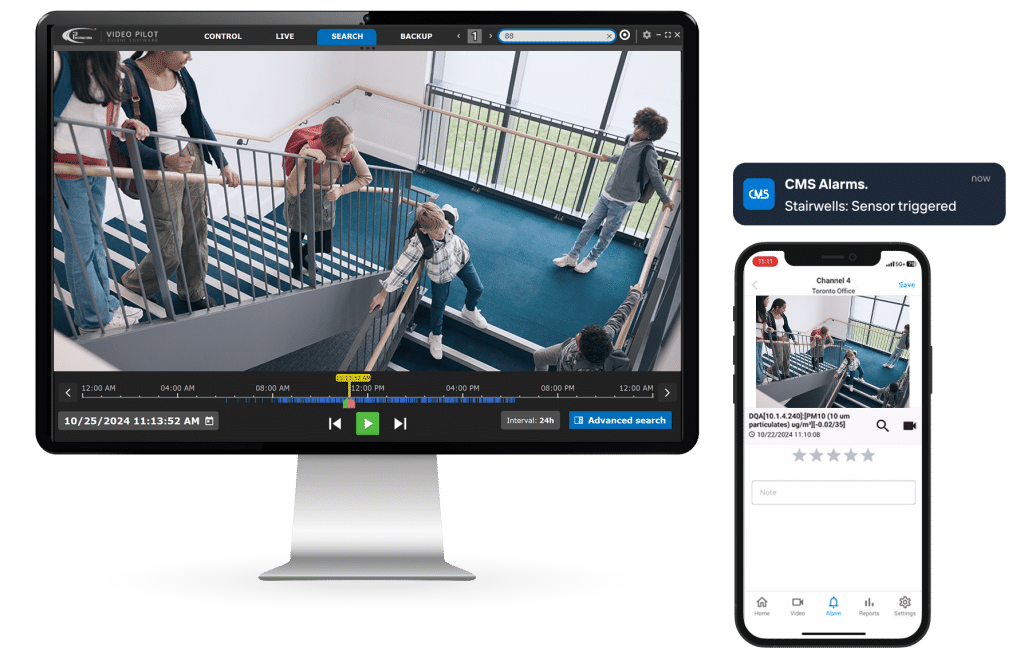
The technology answer (i3): The answer should be minutes, not hours. Ai-Powered search lets staff move from timeline scrubbing to targeted retrieval by person, vehicle, or event. That matters when a parent is waiting for answers or an administrator is trying to establish what happened quickly. The same platform should also keep monitoring system health in the background, so the footage you need is more likely to exist when you need it.
-
Where can school security cameras go, and where should they not go?
The integrator’s answer (Haig): Some spaces require privacy, even when they are closely tied to risk. Restrooms and locker rooms are the obvious examples. A stronger design uses privacy-safe sensors in those areas and places cameras in adjacent hallways and transition zones. That gives the district situational awareness without crossing a line it should not cross.
The technology answer (i3): Smart Sensor Integration helps close the visibility gap around camera-free spaces. A sensor alert should automatically surface the nearest hallway views and a usable event timeline, so administrators can understand movement into and out of the area without monitoring the protected space itself.
-
How do districts fund school security upgrades, and what do grant reviewers want to see?
The integrator’s answer (Haig): Start with the documented security need, not the funding source. Reviewers want to see a defined risk, a clear plan, and a district that can sustain the investment after award. A capable integrator should help align the project with available funding and surface procurement requirements early, before a good plan stalls in the buying process.
The technology answer (i3): Reviewers are more likely to support a plan that is expandable and defensible than one built around disconnected purchases. A district should be able to explain how the initial investment establishes a foundation it can build on over time, rather than creating a replacement cycle with every new phase. That is especially important when districts are applying for school security grants or planning multi-year school safety improvements.
-
How is student privacy protected, and who can access school surveillance footage?
The integrator’s answer (Haig): Privacy should be built into the deployment model from the start. That means role-based access, controlled export permissions, and clear auditability. The district decides who needs access. The system and service model should make sure nobody else has it.
The technology answer (i3): Privacy is not a policy statement unless the platform can enforce it. Access to footage should be role-based. Views and exports should leave an audit trail. Retention should align with district policy. Sensitive evidence should move through Encrypted Video Transfer, not improvised file-sharing methods. When districts evaluate cloud-connected systems, independently documented security controls matter. i3’s cloud-managed platform is SOC 2 Certified.
-
Should school security, fire, and life safety work under the same service strategy?
The integrator’s answer (Haig): Security does not have to live under the same contract as fire and life safety, but it should be managed with similar discipline. Fire systems come with required inspections and documentation. Security often does not, even though uptime matters just as much during an emergency. A coordinated service approach gives the district a clearer operating model.
The technology answer (i3): Separate systems should still contribute to one operational picture. When life-safety signals and security systems can surface context together, responders get more than an alarm. They get a clearer understanding of what is happening and where attention is needed first.
-
Should a district choose cloud, on-prem, or hybrid video surveillance for schools?
The integrator’s answer (Haig): There is no universal answer, but hybrid often gives districts the best balance. Cloud can improve access and oversight. On-prem can preserve local control and recording continuity. The right architecture depends on bandwidth, cybersecurity requirements, staffing capacity, and the infrastructure already in place.
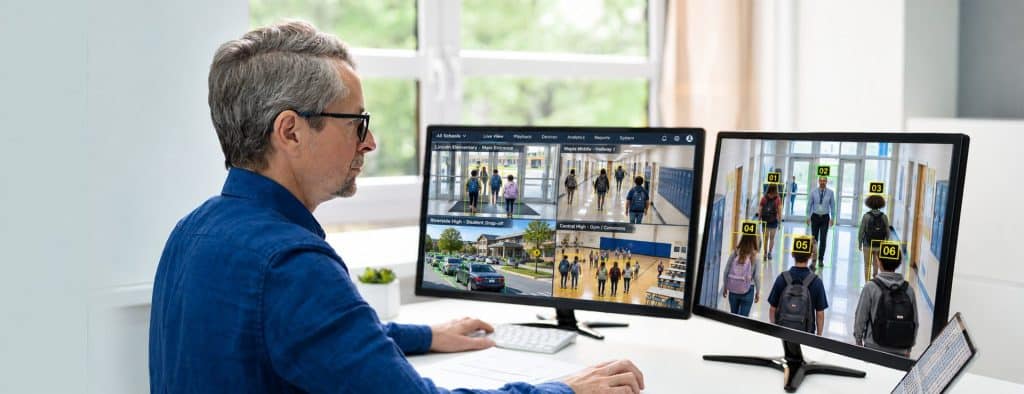
The technology answer (i3): For many districts, hybrid is the pragmatic model. Local recorders preserve continuity if the internet drops. A Scalable Cloud Infrastructure layer gives IT centralized health monitoring, remote access, and cross-campus visibility. The district keeps local resilience while improving system-wide oversight.
-
What happens to school security response time after hours and during breaks?
The integrator’s answer (Haig): After-hours response should not depend on guesswork. Roles, escalation paths, and response expectations should be defined before the district needs them. Both the district and the integrator should know who gets notified, who makes the call, and what happens next.
The technology answer (i3): Risk does not disappear when buildings are quiet. Automated monitoring, Incident Management Alerts, and remote access should continue 24/7/365. Ai-Powered detection can keep surfacing events during evenings, weekends, and breaks, when empty campuses may be more exposed and fewer people are on site to notice issues quickly.
-
How do we avoid lock-in when expanding a K-12 school security system?
The integrator’s answer (Haig): The district should evaluate what expansion looks like before the first purchase, not after it. Can another building come online without replacing what already works? Can storage grow without forcing a reset? Can the district make choices next year without undoing this year’s investment? Those are design questions, not post-purchase questions.
The technology answer (i3): Scalability should mean phased growth, not repeated replacement. A standards-based platform gives districts more room to add capacity and capabilities incrementally while preserving more of the infrastructure already in place. If expansion requires a rip-and-replace cycle, the district is not gaining flexibility.
-
What should a summer service window accomplish before day one?
The integrator’s answer (Haig): Summer is when districts should find the problems they do not want to discover in the first week of school. Test every camera. Confirm recording and retention. Validate storage capacity. Clean and refocus devices. Resolve deferred issues with enough time to retest before students return. Day one should confirm readiness, not begin discovery.
The technology answer (i3): By day one, every building should show healthy system status from one dashboard. The summer window should close out recorder and camera health checks, retention validation, firmware review, and testing of the workflows staff will rely on under pressure, including Ai-Powered search, sensor-triggered workflows, and Real-Time Alerts.
What these ten school security questions actually reveal
Taken together, these questions point to a larger truth. School security is not just a procurement decision. It is an operating model.
The technology determines what the district can see, how quickly it can search, how tightly it can control access, and how well it can scale. The integrator determines whether those capabilities remain reliable through maintenance, validation, communication, and accountable service.
District leaders should be able to name who owns each part before any agreement is signed. That is a better test than a polished demo or a long feature list. The useful question is whether the district can point to a school security plan, a service model, and a system architecture that will still hold up when the first real incident happens.
Conclusion
Superintendents do not need more vendor language. They need a clearer framework for evaluating school security solutions, campus safety technology, and long-term student safety investments.
These ten questions are a starting point.
If a district cannot get direct answers to them before a purchase, it will likely have to answer them the hard way after deployment.