
Convenience stores have spent the last few years borrowing from quick-service restaurants. Now, 7-Eleven’s latest leadership appointments signal a growing influence from grocery, bringing three retail formats closer together than ever.
For the past few years, convenience stores have been taking cues from quick-service restaurants, expanding their prepared food offerings, introducing made-to-order meals, and placing greater emphasis on speed of service. This evolution, which we coined as the QSRification of convenience stores, has reshaped what customers expect from a quick stop.
Now another transformation is taking shape, and this time, grocery is leading the conversation.
The grocerification of convenience stores describes the growing adoption of supermarket practices within convenience retail, from fresh food merchandising and private-label development to inventory management, loyalty programs, and digital commerce. It represents a shift toward managing convenience stores with the same attention to product availability, customer behaviour, and operational consistency that grocery chains have developed over decades.
7-Eleven’s latest leadership appointments offer an interesting glimpse into where this evolution is heading.
On November 20, 2026, the company announced that Scott Neal, formerly of Sprouts Farmers Market and Walmart’s fresh food business, would join as chief merchandising officer. Keith Nicks, previously responsible for commercial and digital operations at Ahold Delhaize USA, was appointed chief growth officer. Both executives are scheduled to begin their roles on November 30.
Their combined experience points to a clear priority: strengthening the relationship between what convenience stores sell, how customers shop, and how consistently those experiences are delivered.
Why 7-Eleven is taking a page from the grocery playbook
7-Eleven’s leadership changes arrive as the company advances its North Star strategy, a multiyear initiative focused on improving store operations, expanding foodservice, and modernizing the customer experience.
The company plans to remodel thousands of North American stores through 2030, alongside a broader franchise conversion strategy. These investments range from foundational improvements to larger-format, food-focused locations designed to accommodate changing shopping habits. The emphasis on fresh food is supported by wider industry trends.
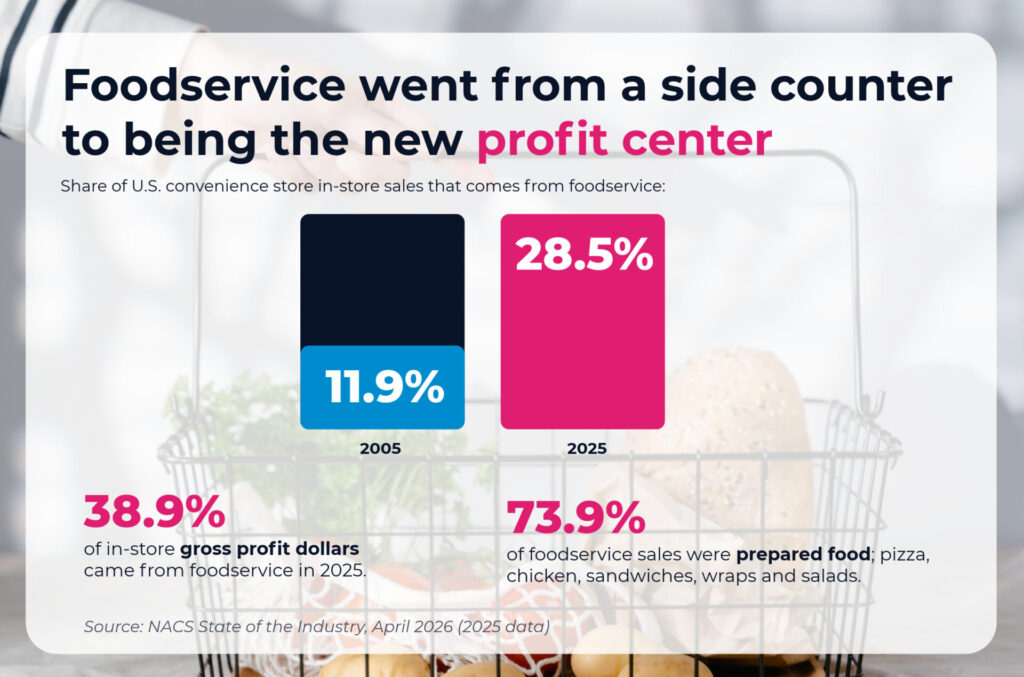
According to the National Association of Convenience Stores (NACS), foodservice represented 28.5% of U.S. convenience store in-store sales in 2025, compared with 11.9% in 2005. Its contribution to profitability was even greater, accounting for 38.9% of in-store gross profit dollars. Prepared food represented 73.9% of total foodservice sales.
As prepared food becomes increasingly important to convenience retail, the operational expertise traditionally associated with grocery becomes equally valuable.
Fresh products require careful planning around availability, demand, waste, and replenishment. Private-label programs introduce opportunities to differentiate offerings and strengthen margins, while loyalty and digital commerce provide a clearer understanding of purchasing behaviour.
These are familiar priorities for supermarket operators, and they are becoming central to the convenience store business.
For 7-Eleven, bringing grocery expertise into merchandising and growth leadership reflects the importance of connecting these disciplines with its broader store transformation strategy.
When grocery, QSR, and convenience begin to look alike
The movement between retail formats extends well beyond 7-Eleven.
Convenience retailers have increasingly adopted restaurant practices to support growing foodservice operations. Casey’s General Stores, for example, has been recognized for its restaurant-oriented approach to prepared food, service execution, and consistent in-store sales performance.
Leadership experience is crossing industry boundaries as well. The Wills Group, parent company of the Dash In convenience chain, recently appointed former Jack in the Box CEO Lance Tucker as chief financial officer, bringing restaurant industry experience into convenience retail.
Meanwhile, grocery chains have expanded their own convenience offerings through grab-and-go meals, self-checkout, smaller shopping formats, and prepared food counters. Not to mention the fuel stations that a lot of times are found right outside supermarkets’ doors, providing the full customer journey with the essentials they need.
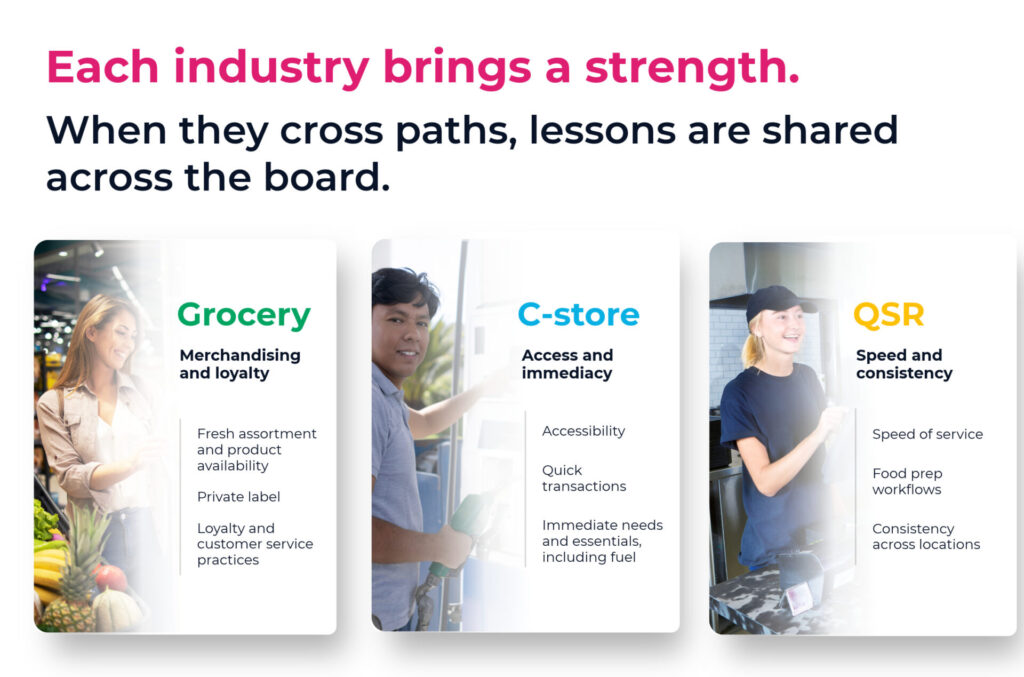
Each industry brings a different strength to the relationship. Grocery has developed sophisticated approaches to merchandising, inventory control, and customer loyalty. QSR has refined speed of service, food preparation workflows, and consistency across locations. Convenience has built its identity around accessibility, quick transactions, and meeting immediate customer needs.
As these strengths come together, operators are managing increasingly similar challenges.
A grocery store with a prepared food counter must consider service speed alongside inventory availability. A convenience retailer expanding its fresh food selection must manage waste and product replenishment more carefully. A QSR operator introducing new ordering and pickup options must coordinate customer traffic, employee coverage, and service expectations.
The result is a growing need for consistent operational visibility, regardless of the retail format.
Four priorities connecting all three industries
Although grocery, QSR, and convenience retailers serve different shopping occasions, their operational priorities are becoming closely aligned. Four areas are particularly important as businesses expand their offerings and seek greater consistency across locations.
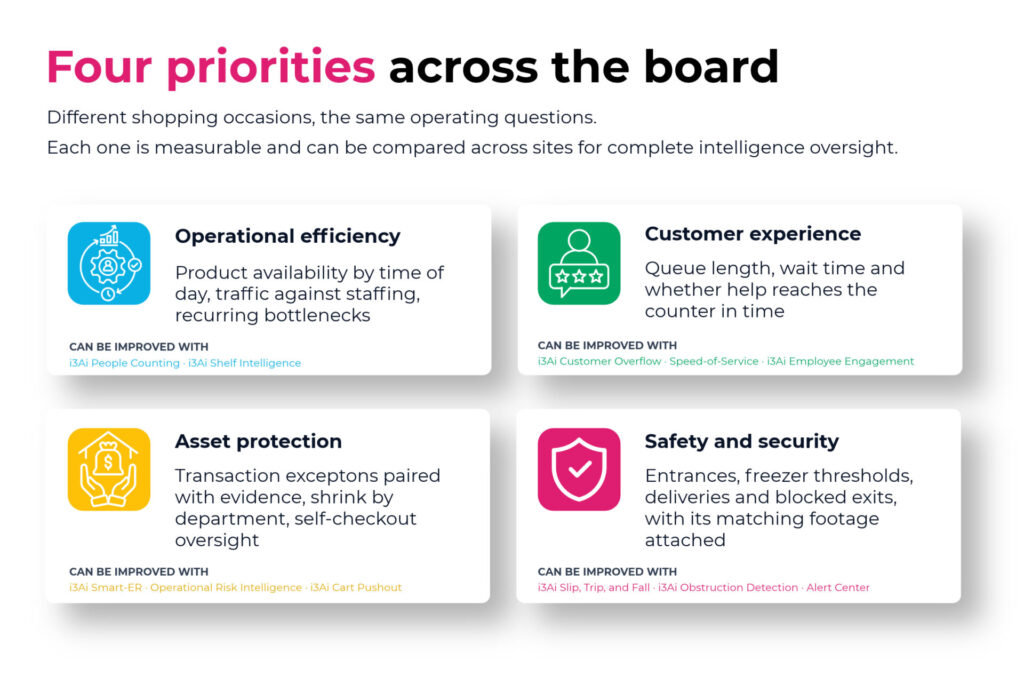
1. Operational efficiency: Making every store work smarter
As convenience stores expand into fresh food, their operations become increasingly complex. Managing prepared meals, beverages, packaged merchandise, and fuel requires careful coordination between staffing, inventory, and customer demand.
Grocery operators have long relied on detailed measures of product availability, sell-through rates, waste, and replenishment to protect margins. Those practices become particularly valuable when convenience retailers introduce products with shorter shelf lives and greater variability in demand.
QSR operators face similar pressures, balancing food preparation times, staffing levels, and order volumes throughout the day.
Across all three formats, operational efficiency depends on understanding how individual locations perform and where resources can be allocated more effectively.
For convenience retailers, this could mean reviewing fresh food availability by time of day, comparing customer traffic with employee schedules, or identifying recurring bottlenecks that affect productivity.
Consistent measurements allow regional managers to compare performance across locations while giving individual store teams the information needed to make timely improvements.
2. Customer experience: Delivering convenience at every touchpoint
Convenience is increasingly defined by the quality of the entire shopping experience, from finding the right product to receiving assistance and completing a purchase.
Customers visiting a convenience store for a prepared meal may have expectations similar to those visiting a QSR. They want fresh options, straightforward ordering, and a reasonable wait.
As stores introduce coffee stations, food counters, self-checkout terminals, and additional services, customer traffic becomes more complex. These touchpoints create opportunities to improve the experience, but they also require greater coordination between employees and service areas.
Grocery retailers face many of the same considerations, particularly during peak shopping periods when checkout congestion and limited employee availability can affect service quality.
Understanding traffic patterns, queue duration, and customer engagement helps operators recognize where additional support may be required.
The goal is a consistent experience that brings together product availability, attentive service, and efficient movement throughout the store.
3. Asset protection: Protecting margins as operations expand
Greater product variety and more complex service models also introduce new considerations for asset protection.
Fresh food programs require close attention to waste, inventory discrepancies, and transaction accuracy. Self-checkout and multiple payment points can create additional areas that benefit from oversight, while the growing number of transactions across stores makes consistent exception review increasingly valuable.
Grocery operators have extensive experience managing shrink across departments, using transaction information, inventory controls, and investigative processes to understand potential losses.
Convenience and QSR operators can apply similar practices as their merchandising and service models evolve.
By examining point-of-sale exceptions alongside operational data, businesses can identify recurring patterns, evaluate procedural gaps, and determine where additional controls may be beneficial.
Importantly, asset protection also contributes to stronger operational processes. Understanding why losses occur can reveal opportunities to improve employee training, transaction handling, and store procedures.
As convenience retailers adopt more grocery-style merchandising, these practices become an increasingly important part of protecting profitability.
4. Safety: Supporting customers, employees, and daily operations
Safety remains a shared responsibility across all three industries, particularly as stores introduce more equipment, food preparation areas, and customer service points.
High-traffic entrances, food preparation stations, freezer thresholds, and storage areas can present different risks throughout the day. Deliveries and restocking activities also require teams to maintain clear access routes and safe working conditions.
These considerations are especially relevant to convenience retailers expanding their foodservice operations.
7-Eleven’s North Star strategy places significant emphasis on improving the condition, reliability, and overall experience of its stores, reinforcing the importance of safety as part of operational excellence.
For operators managing multiple locations, consistent inspections, incident documentation, and timely responses help strengthen safety practices across different teams and shifts.
Analyzing incidents over time can also reveal recurring concerns, allowing organizations to identify locations or conditions that may benefit from additional attention.
What convenience retailers can take from this shift
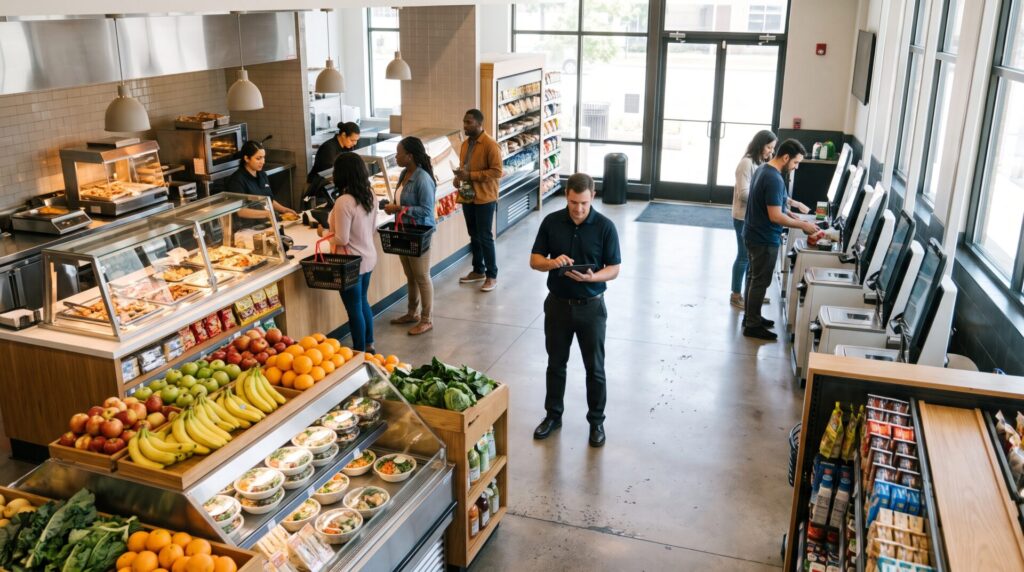
The grocerification of convenience stores offers lessons that extend beyond national chains undertaking large-scale transformations.
For operators expanding their foodservice offerings, a useful starting point is treating fresh food as a distinct business priority, with regular attention to sales, availability, waste, and demand throughout the day.
Customer traffic and service data can help align employee coverage with busy periods, particularly when stores introduce additional ordering or pickup points.
At the same time, reviewing transaction exceptions and recurring safety concerns can help managers understand how changing operations affect margins, employee responsibilities, and customer experiences.
These practices become even more valuable when information can be compared across locations. Consistent reporting helps operators identify successful approaches, understand differences between stores, and apply improvements throughout their network.
The opportunity lies in bringing these measurements together so operational decisions reflect the full picture of store performance.
Bringing it all together with i3 International
As grocery, QSR, and convenience retail continue to converge, operators need technology that can support a wider range of business priorities while maintaining consistent visibility across locations.
This is where i3 International brings the different disciplines together.
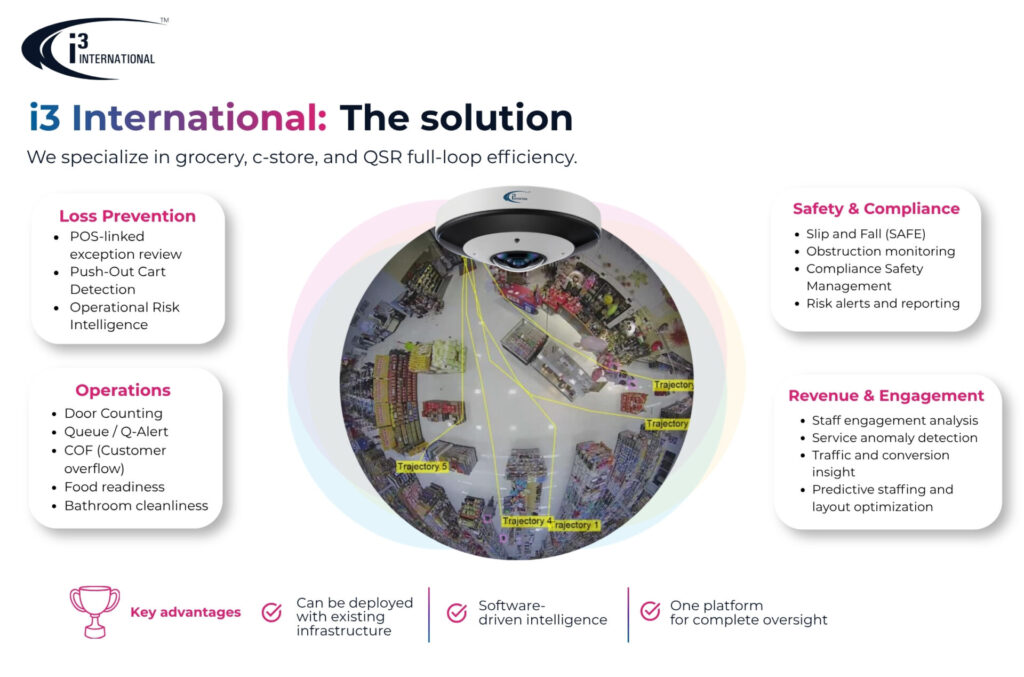
Through its integrated AI video analytics platform, i3 helps retailers connect operational efficiency, customer experience, asset protection, and safety within a centralized environment.
Solutions such as People Counting, Shelf Intelligence, Customer Overflow, and Speed-of-Service analytics provide insight into store traffic, product availability, and service conditions. Employee Engagement helps operators understand staff coverage and customer interactions, while Smart-ER connects point-of-sale exceptions with video to support asset protection investigations.
Safety applications, including Slip, Trip, and Fall detection and Obstruction Detection, add another layer of awareness by identifying events that require attention and providing supporting video for review. Helping stores address incidents before they become an OSHA citation
Together with i3’s Alert Center, CMS, and i3HOST, these capabilities help multi-site operators access relevant information, coordinate responses, and evaluate performance across their locations.
Where compatible, these solutions can also extend the value of existing camera infrastructure, allowing retailers to introduce additional intelligence as their operational needs evolve.
For businesses navigating the growing overlap between grocery, QSR, and convenience, a connected approach offers a way to manage different priorities through a consistent platform.
The next chapter of convenience retail is already taking shape
7-Eleven’s latest leadership appointments reflect a broader shift in how retailers are thinking about growth. Grocery expertise is finding a place in convenience, restaurant practices are shaping service expectations, and all three industries are learning from one another.
As the boundaries between these formats continue to evolve, the businesses best positioned to adapt will be those that understand how their stores perform across every aspect of the customer experience.
Fresh food availability, service speed, employee efficiency, asset protection, and safety are increasingly connected parts of daily operations. Bringing greater visibility to these areas gives retailers a stronger foundation for making decisions, improving consistency, and supporting growth.
The future of convenience retail will be shaped by how effectively operators bring together the strengths of grocery, QSR, and convenience. With connected intelligence supporting that effort, retailers can deliver a more consistent experience while making better use of the infrastructure and resources they already have.
Explore how i3 International’s AI-powered video solutions can support your operations across grocery, QSR, and convenience retail.
Frequently asked questions
How is grocerification different from QSRification?
QSRification describes the adoption of restaurant-style practices within convenience stores, including made-to-order food, drive-thru operations, and speed-of-service management.
Grocerification builds on this evolution by introducing grocery disciplines such as fresh food merchandising, product availability, private-label development, loyalty programs, and inventory management. Together, these influences are expanding the role of convenience stores in everyday shopping and dining.
What operational priorities do grocery, QSR, and convenience retailers share?
All three formats must balance operational efficiency, customer experience, asset protection, and safety. While their individual business models differ, each benefits from understanding customer traffic, service demand, employee coverage, inventory performance, transaction activity, and workplace conditions.
How can AI video analytics support these changing operations?
AI-powered video analytics can provide insights into store traffic, customer queues, employee engagement, transaction exceptions, and safety events. When connected through a centralized platform, these capabilities can help operators identify patterns, respond to events, and compare performance across locations.
Do convenience stores need new cameras to adopt AI analytics?
Many AI video applications can operate through compatible existing camera infrastructure, depending on the solution and installation requirements. i3 International supports flexible deployments that allow retailers to build on existing systems where possible.
How important is foodservice to convenience store profitability?
According to NACS data for 2025, foodservice generated 28.5% of U.S. convenience store in-store sales and contributed 38.9% of in-store gross profit dollars. Prepared food accounted for 73.9% of foodservice sales, reinforcing its importance to convenience retail operations.